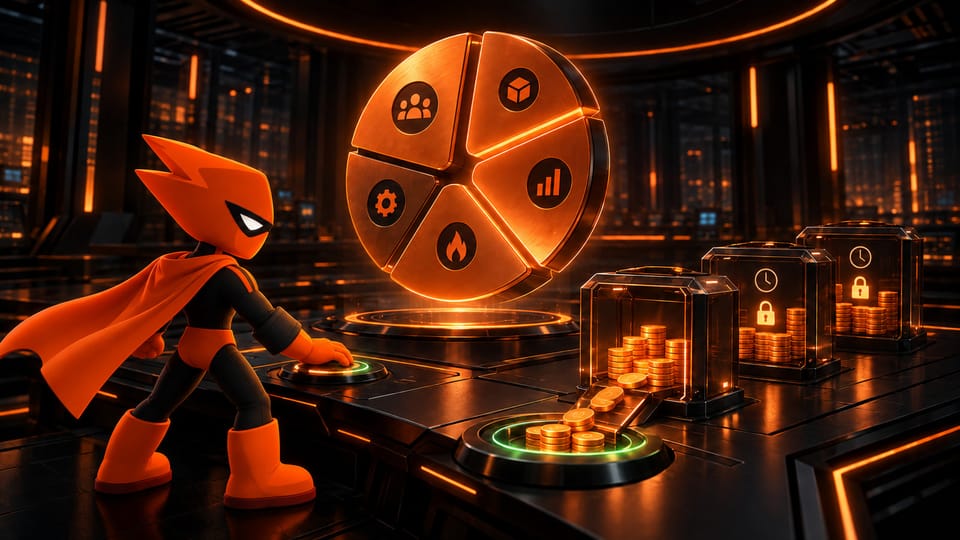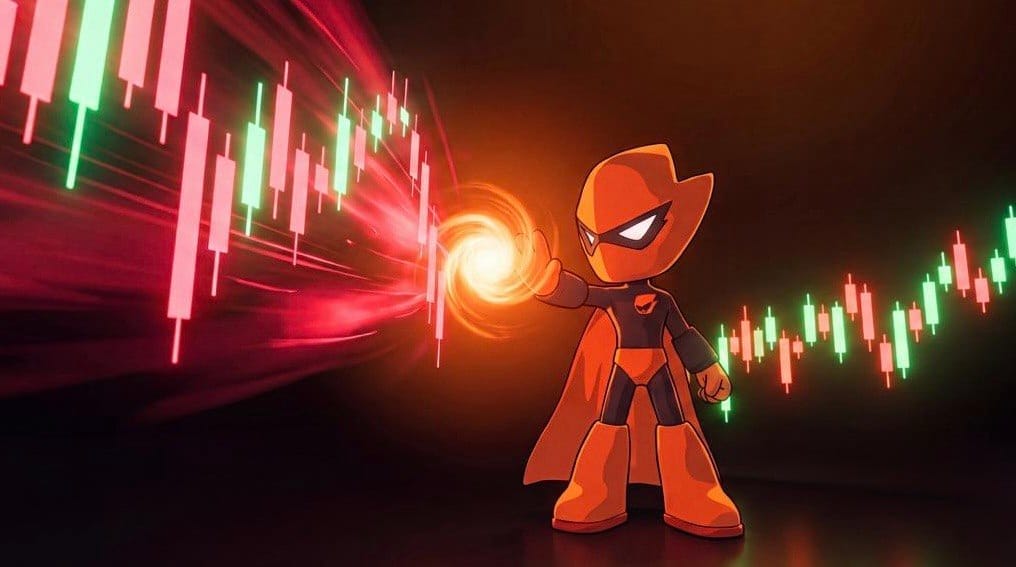
A counter trade is an automated response to someone else's trade: when a buy lands in your pool, you sell a fixed percentage of its size; when a sell lands, you can buy a percentage of it. No schedule, no standing orders. The market moves first, and the strategy responds in proportion.
Mechanically it's simple. What's worth understanding is who it's for. Token teams often hold a meaningful share of supply and will eventually need to sell some of it. A large sell placed at a bad moment has a large price impact: the team gets a worse price, and every other holder takes the hit too. Counter trading is a way to execute those sales in small pieces, at moments when there is real demand to trade against.
Liquidity arrives in bursts
Memecoin volume doesn't flow evenly; it surges. There can be hours of near-silence, then a wave of buys when a post lands or a narrative catches, then a wave of sells as short-term traders rotate out. A fixed selling schedule will regularly disagree with that rhythm. Sell on your own clock and sooner or later you're selling into a thin market with few buyers, which means high slippage and a poor fill for you, and a sharp price drop for everyone else holding.
The practical conclusion is an execution one: the time when your sell will cost the least in price impact is when there is buying to trade against. Counter trading ties your execution to that moment automatically.
Execution with lower price impact
Here's the arithmetic. Say you run a 20% counter-sell: for every buy that lands in your pool, you sell 20% of its size. A 10 SOL buy wave triggers roughly 2 SOL of selling, executed while that buying is happening. Because each sell is small relative to the demand in the pool at that moment, its price impact is small too. This is the same idea as a VWAP or participation-rate order in traditional markets: trade a fixed share of real volume instead of one large block.
Every one of those sells is a normal, public on-chain transaction from your wallet. Anyone can see it in the trade history or on a block explorer. Counter trading changes when and how much you sell, not whether people can see that you sold.
The other direction works the same way. If you enable counter-buy, the strategy buys a percentage of incoming sells, sized by your settings and limited by the funds you allocate to it. That adds liquidity on the buy side when sellers are active. It does not target a price, and it won't hold one. It is bounded by your budget, and a sustained move will go straight through it.
Under the hood, a counter-trade engine is more selective than reacting to every trade. It only responds to confirmed on-chain trades. It filters out MEV bots, because responding to them only feeds them. It has a minimum trigger size so dust trades don't set it off, a maximum so a single large trade can't provoke an oversized response, and an optional randomized capture percentage so front-running bots can't predict your order sizes. And it's bounded by inventory, by per-trade caps and by your project-level limits, because a counter trade is still a trade with real risk.
What this buys you
- Sells land when there is demand to trade against. By construction, the trigger is the demand.
- Lower price impact per trade. Many small fills instead of one large block, which means a better average price for you and less disruption for other holders.
- Proportional by design. Sizing is a percentage of real flow. Quiet market, quiet strategy. It never creates activity that isn't there.
- It's real trading. Every counter trade fills against an independent counterparty on the other side, with real risk transfer. That's the categorical difference between counter trading and wash trading or volume botting, which trades against itself to fake activity.
What counter trading is not
- Not a way to hide selling. Every trade is public on-chain and attributable to your wallets. If your holders would want to know that the team is selling, tell them.
- Not a price target. The strategy reacts to trades with fixed percentages. It does not try to hold, set or move the price to any level, and you shouldn't configure it with that goal.
- Not fake volume. It only trades when someone else has traded first, and always against them.
- Not a substitute for compliance. Rules on market conduct, insider selling and disclosure differ by jurisdiction and by token. You are responsible for following the ones that apply to you; take legal advice if you're unsure.
Running Counter Trade on Sumo
Counter Trade is the flagship strategy on Sumo. The configuration surface maps to everything above: pick a direction (counter-sell on buys, counter-buy on sells, or both), set the capture percentage and an optional randomized range, set minimum and maximum trigger sizes, slippage tolerance, and MEV wallet filters. It runs on tokens you launched through Sumo or on anything you plug in with Import Token.
One requirement that's easy to underestimate: a counter trade is only as good as its landing time. React to a buy fifteen blocks late and you're no longer trading against that demand; you're selling into whatever came after it, at whatever price that is. Sumo lands counter orders in a single block with over 99.9% reliability, close enough to the trade it's responding to for the participation model to hold.
Prefer watching to reading? The full Counter Trade deep dive walks through setup, configuration, and live examples:
Tips from the desk
- Start modest. A 10–20% capture rate keeps each fill small. Tune it against your own flow data, not your instincts.
- Set the min trigger above dust. You want to respond to real trades, not automated noise.
- Cap the max trigger. A single very large buy shouldn't be able to pull an outsized sale from your inventory.
- Budget the buy side explicitly. Decide in advance how much the counter-buy side may spend, and treat it as a trading position with its own risk.
- Know a trend from a burst. Counter trading works best when flow goes both ways. If the market is genuinely repricing your token, up or down, keep the strategy within tight limits or pause it.
- Disclose your plans. Tell your community that the team runs automated market operations and roughly what they do, such as a selling plan or a liquidity budget. Transparency is what separates professional market operations from deception, and on-chain it's all visible anyway.
Counter trading won't revive a dead token, and it won't make selling free. What it does is execute the sales a team needs to make in a way that trades against real demand, in small pieces and in the open. Liquidity arrives in bursts, so trade with it.