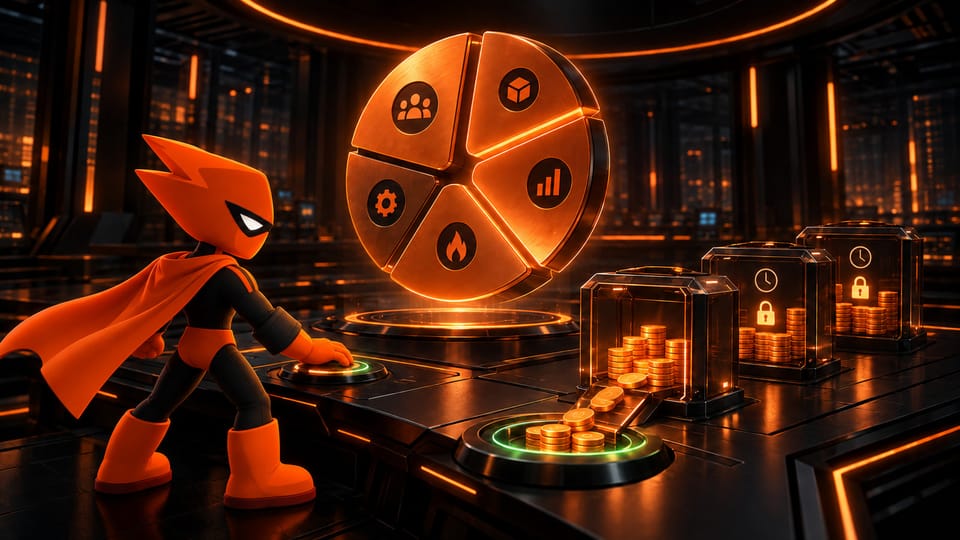
Here is the math nobody puts at the top of a launch guide: roughly 24,000 memecoins launch every day on Pump.fun alone, and as of this year the share that graduates its bonding curve has collapsed to about 0.26%. Three-quarters of launched tokens are effectively dead within 24 hours; 93% within a month.
Most guides respond to those numbers with "make a better meme." We'd point somewhere else. A large share of launch failures have nothing to do with the meme, the timing, or the founder's effort — they're inflicted by the launch stack itself: the dev you hired, the contract you trusted, the market maker you signed. Those are the failures this guide is about, because they're the ones you can actually engineer away. The meme is your job. The rest shouldn't be able to kill you.
The parts that are actually your job
Concept, narrative, community. A memecoin is a story with a ticker: if the story isn't legible in one image and one sentence, no amount of launch engineering saves it. Before anything technical, you need a name and visual identity that survive being screenshotted out of context, a reason this exists now (narratives have a shelf life measured in days), and a community channel that feels alive before the token does. Every guide on the internet covers this part, most of them adequately — we won't relitigate it. What they don't cover is everything below.
Choosing your launchpad in 2026
The launchpad decides your bonding curve mechanics, your fee economics, and who sees you first. The current landscape, briefly:
- Pump.fun — still the default, with 60%+ of Solana launches. Maximum eyeballs, maximum competition. Its 2026 creator-fee overhaul matters more than most founders realize: fees can now be split across up to 10 wallets with transferable ownership, and you must choose at launch between keeping creator fees or directing them to trader cashback — a decision that is locked forever. Decide it deliberately, not at the deploy screen.
- LetsBONK — Raydium rails, a strong aligned community, and far less front-page competition than Pump.fun.
- Moonshot — mobile-first with Apple Pay onboarding; reaches buyers who have never held SOL.
- Raydium LaunchLab and Meteora DBC — infrastructure-grade launch paths for teams that care about pool mechanics after migration.
- Beyond Solana — Robinhood Chain is the newest frontier, with retail-native flow and almost no meme tooling built for it yet; Base pairs a mature memecoin scene with deep Uniswap liquidity behind every pool; and Four.meme on BNB and SunPump on Tron carry real, underserved flow of their own. Being early to a chain's meme scene is a legitimate edge.
Sumo launches to all of the above from one place, which turns this from a commitment into a parameter. But wherever you launch, the pad is the venue — the next three sections are about the things that actually kill you.
Failure mode #1: the launch dev
The standard path for a non-technical founder is to hire a "launch dev" — someone from a Telegram group or a marketplace who handles deployment, wallets, and the bundle. You are handing this person your treasury, your token authorities, and the most valuable thirty seconds your project will ever have.
Consider the strongest possible reference check: Pump.fun itself hired a senior developer in 2023. Six weeks later he used his internal access to siphon roughly $2 million from the platform's bonding curves, scattering it to random wallets mid-spree. He was sentenced to six years. That was the biggest launchpad in the world, with contracts, an office, and a legal team — and it still couldn't de-risk one dev hire. Your anonymous launch dev, paid in the token he's about to control, is bonded by nothing at all.
And outright theft is the loud version. The quiet versions are more common: allocations you didn't approve tucked into the bundle, authorities that never get revoked, and — most common of all — the dev sniping your launch with wallets you don't know about, using the timing information only he has. You find out weeks later, if ever.
Failure mode #2: the code
In April 2022, the AkuDreams team launched with a custom auction contract. One logic bug — which outside developers warned them about and the team waved off as "a feature" — permanently locked 11,539 ETH, about $34 million at the time. Not stolen: locked. No admin key, no recovery, no appeal. The funds are still there.
That was a well-funded team with a real audience. The long tail is worse: an analysis of new Base memecoins found 91% carried contract vulnerabilities, and investors lost over $500 million to memecoin rugs and scams in 2024 — a meaningful slice of which were not malice but incompetence: broken sell paths, unrevoked mint authority, fee logic that soft-locks the pool.
The lesson is not "audit harder." It's that bespoke launch code is unexploded ordnance, and in 2026 there is no reason to ship any. The canonical launchpad contracts have processed millions of launches; the failure modes live almost entirely in the custom layer people bolt on top — and in the hands doing the bolting.
Failure mode #3: the market maker
The most instructive token disaster of the past two years wasn't a rug — it was a market-making agreement. Movement Labs, a project that raised at a multi-billion valuation, signed liquidity deals that routed 5% of its supply through a middleman under side agreements its own leadership apparently didn't fully understand. On listing day, wallets tied to the market maker dumped $38 million of the token. Exchanges banned the firm, the co-founder was suspended and later left, and this month the company filed for Chapter 11.
That's the documented, headline version of a pattern that mostly stays private: agreements whose incentives quietly point at dumping on your holders, inventory that trades in venues you can't see, and performance you can't verify because the reporting comes from the counterparty. At memecoin scale the same conflict shows up smaller and faster — including operators who snipe the very launches they're paid to support. On-chain researchers have documented thousands of launches where insider-funded wallets sniped the first block, with an 87% hit rate on profitable snipes. Every lamport an insider extracts at your open is money that would otherwise have accrued to you and your holders. It is, functionally, theft from the founder — executed by the people the founder is paying.
The trustless launch: be your own dev, be your own market maker
Look at the three failure modes together and they share one shape: a third party you had to trust, and couldn't verify. The fix isn't better vetting. It's removing the third party.
That is the entire design thesis of Sumo. You are the launch dev: launches and bundles run through the same battle-tested execution layer on every major pad, from your own wallets, with nobody else holding keys, authorities, or timing information. Your bundle defends the open against the sniper wall — and on that note, one sentence of principle: bundle for defense, and disclose your team's position to your holders; transparency is what separates market operations from deception. (Our bundler comparison goes deeper on doing this properly.)
And you are the market maker: strategies like Counter Trade, DCA, and limit orders run your market operations from your own treasury, with every fill visible in your own terminal. No supply leaves your custody, no side agreements exist because there is no counterparty to sign one, and nobody snipes your launch with your own information because nobody has your information.
What's left to worry about? Marketing. Genuinely — that's the design goal. The launch can't be stolen, the code path is the same one that's executed millions of launches, and the market operations are yours. The failure modes that remain are the honest ones: the meme, the narrative, the community. Which is exactly how it should be — those are the parts a founder is for.
What's left: the founder's actual job
With the stack de-risked, spend yourself where a human is irreplaceable: shipping the story (memes, formats, moments — daily), being present (dead founder chat reads as a dead token), converting attention spikes (every burst of volume is a recruiting event for holders — handled well by your market operations, handled socially by you), and playing the long game past the first week, which is where the 0.26% separate from the rest. Launch and market operations are solved problems in 2026. Attention isn't. That asymmetry is your job description.
FAQ
How much does it cost to launch a memecoin?
Launchpad deployment itself is nearly free (Pump.fun charges no upfront deploy fee; the curve takes its cut in trading fees). The real costs are your initial buy/bundle allocation — sized to your defense needs, not a fixed number — and tooling: Sumo charges $250 flat or 0.25% of supply for launching, and 1% of volume (with cashback) for trading.
Do I need to know how to code?
No. In 2026 writing your own token contract is not just unnecessary — as the $34M AkuDreams lock shows, it's where the catastrophic risk lives. Launchpad contracts plus a self-serve terminal cover the entire technical surface.
Do I need a market maker?
You need market making — someone keeping your token liquid and managing your treasury. You don't need a market maker — a counterparty holding your supply under an agreement you can't verify. Run the strategies yourself; that's what they're for.
Why do most memecoins fail?
The visible reasons are story and community — most tokens never give anyone a reason to care. But among launches that did have real demand, the deaths concentrate in the stack: a launch dev who skimmed the bundle or sniped his own client's open, code that broke or locked funds, a market-making arrangement whose incentives quietly pointed at dumping on holders, and a first block handed to snipers. Much of a token's fate is decided before the founder posts a single meme. Story and community are on you; everything else on that list is an engineering problem — and in 2026, a solved one.